More than just a cheap pop film, A Hard Day’s Night has become an enduring classic
The Beatles film career is one of that can best be defined as ‘early promise unfulfilled’. From the heights of their debut through to the failed projects and the lacklustre and bleak cut of Let it Be, it could have been so much more, but what did the Beatles themselves make of the first experience of the silver screen?
From the moment that the first Beatle movie was mooted, the fabs were adamant that they did not want to be in a silly pop movie, perhaps with an eye on the future, they already saw that they were developing and did not want to be part of something that would later become an embarrassment.
With Director Richard Lester attached, who had previous comedic form with the Goons, one of John’s favourites, A Hard Day’s night promised to be anything but.
To help things be rooted in realism, Alun Owen had been brought on board as to write the script having gained a reputation for being able to write Liverpool dialogue, off the back of writing a TV play called No Trams to Lime St., famous in those days for where the sex workers would hang out, crawling with ‘Maggie Mae’s’ you might say. As a result the film had a realism that other pop films lacked, this was the Beatles being themselves and served not so much as a feature but perhaps an early form of the mockumentary.
“We didn’t want to make a fu**ing shitty pop movie, we didn’t want to make a movie that was going to be bad, and we insisted on having a real writer to write it. He (Owen) stayed with us two days, and wrote the whole thing based on our characters: me, witty, Ringo, dumb and cute, George this and Paul that.”
John Lennon
Perhaps a little unfair of John, the characters that Alun Owen had created where more rounded than that. Paul was the charmer, George the thinker, Ringo the comic and John, in a moment of unerring accuracy was, and continued to be, the cynic. Owen had in two days seen enough to nail down the Beatles and with pinpoint precision too, they would all play these roles on and off-screen for the rest of their time as Beatles and beyond.
Another key thing that he picked-up on was the claustrophobia and the boredom that came with being in the most popular group in the world. This was reflected too in the experience of making the film.
“The waiting around was the staggering thing that we hadn’t realised about films. Everything else was very nice and entertaining, but you were nearly all day waiting while they lit a shot and then you’d come in and go, He’s clean though, and they’d go, ‘Great, thanks, that’s it.’You’d think, Bloody hell. And go home.”
Paul McCartney
‘He’s clean though’, was of course in reference to their co-star Wilfred Brambell, already a household name for his role as the title character in rag and bone sitcom, Steptoe and Son, where we played the very opposite of of his character of Paul’s grandfather, a ‘dirty old man’, who would sometimes bathe in the kitchen sink. And he was just one of a cast of strong supporting characters including Victor Spinetti’s Director and the brilliant Norman Rossington and John Junkin, who in essence played the roles of off-screen fixers Neil Aspinal and Big Mal Evans.
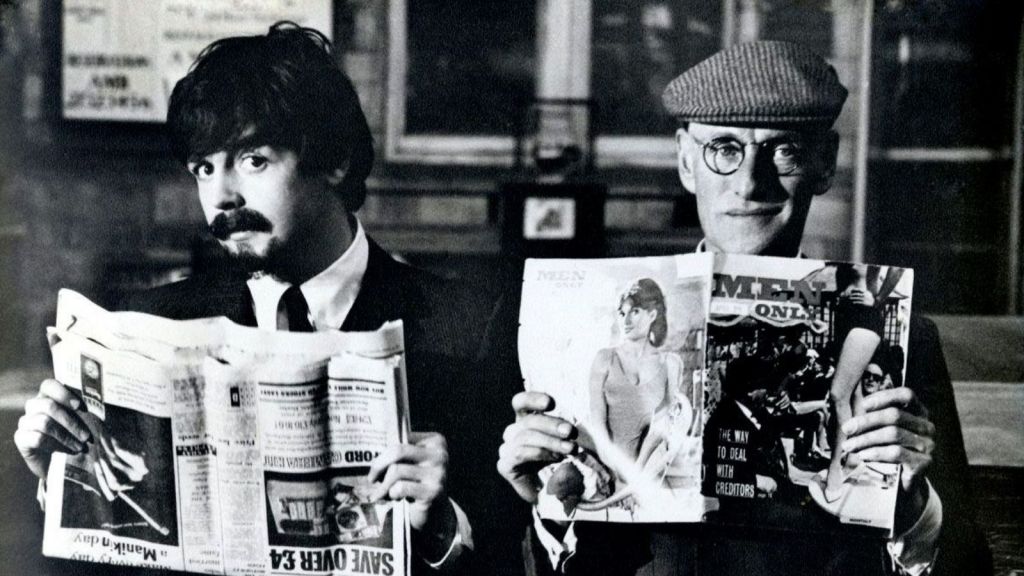
Paul with the ‘very clean’ Wilfred Brambell in a still from the opening scenes
The combination of good casting, Dick Lester’s comic leanings, Alun Owen’s ‘scouse for hire’ dialogue and the Beatles natural screen presence made the film a hit and helped further cement BeatleMania to boot. Although later harshly critiqued by Lennon in later years (What wasn’t?) the Beatles seemed to enjoy the experience.
George would later reflect that he “Loved it! The only thing I didn’t like was having to get up at five in the morning”, and Ringo as the films breakout shared that sentiment “I mean, we were in a movie, man. We were making a movie! Four guys from Liverpool making a movie — it was so great. The whole experience and Ringo’s role in its success was perhaps best summed up by Paul,
“Ringo took to it like a duck to water, there was no holding him back, he was totally in his element.He became the star of the film…The four of us came off well. And what we liked was that it was a film, it wasn’t a vehicle for a rock ‘n’ roll act. It captured our personalities.”
Paul McCartney
It would likely have been a box office hit even if it was a mess, such was the draw of the Beatles at the time, but importantly it was a critical success too with Andrew Sarris of The Village Voice calling it “The Citizen Kane of jukebox musicals.”
It is and stands as one of the most important milestones in their career and arguably one of the key moments in 60s cinema. Not bad for four lads from Liverpool who just a few years earlier could only dream of landing a recording deal never mind a film contract.
 Zap!
Zap! 